Showing posts with label food insecurity. Show all posts

Saturday, May 24, 2014

Our Clean Eating Detox: Day 0 Observations

Because we are pursuing a healthy lifestyle and love to try new things and/or are masochists, J and I are starting a Clean Eating detox tomorrow.

Clean eating is a premise we've flirted with some in our cooking, and find exceptionally intriguing. We recently had a conversation with a friend about how little legitimate food we are actually eating. As a society - if not an global era - we are eating more processed, refined food-like products rather than actual, unadulterated fruits, vegetables, proteins and grains.

Just look at the ingredients on the back of this snack pack of animal crackers. I bought them because they were inexpensive and in a low-calorie serving, but then the ingredients were pointed out to me.

Gotta love the typo too... 
Although clean eating diets do combine elements of several "trendy" diets - low carb, gluten-free, organic - it's based on the solid principal of cooking and eating ingredients that are as close to their natural state as possible. So the summer Cookout shake binge is on hold, but the recipes we're working with for the next two weeks look pretty great.

The detox is a plan we found on Buzzfeed - the black hole into which all 20-somethings fall and lose hours on end - and is thoroughly planned out. Seriously, we're talking 53 pages of menus, FAQs, equipment (paltry) and grocery (insurmountable) lists. The cleanse lasts 14 days and is planned where several "big batch" dishes are made that will be served in several meals so they've scheduled everything perfectly - even the Saturday prep days, what to pack in your lunchbox, how to store it,  and freezer packs with "when to thaw" instructions. Each day includes breakfast, lunch, a day snack, dinner and a night snack. Only a  few of the recipes repeat - only breakfasts and snacks - so it's a ton of variety.

The variety makes for an impressive fortnight menu that's heavy on the veggies and fruits, fatty proteins like nuts and fish, and white meats, but not light on flavor. For example: Day 5 includes a cauliflower omelet, quinoa and blueberry salad with lime and mint, carrots and hummus, salmon with green beans and lentils and blueberries with almonds.


We start our clean eating adventure tomorrow, so today was spent shopping and doing prep - and it was quite an educational undertaking.

First, I'd like to say that the pre-planned grocery lists are very heavy on the first week - so you can do freezer packs and make dishes late in the week, with leftovers continuing into Week 2. With that being said, List 1 had over 60 items on it -- only a few of which we had on hand at our house, spices mostly (Week 2 has 30+). So one of our first lessons was that clean eating is...expensive! 

The plan is designed for one person, so we had to double everything (quite a math struggle - especially with some units/ingredients "quart container of basil"??) and that pushed our bills (yes, bills, more on that later) even higher. Look at the sheer amount of food we had to purchase.
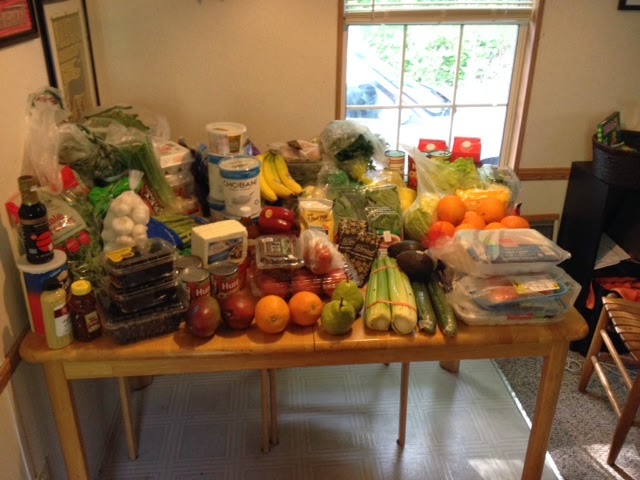
For perspective - this table seats two full-sized chairs per side. We thought we'd have to use the leaf to hold all the food!
This haul included, but was not limited to: 128 oz. plain Greek yogurt, 24 oz. feta cheese, 24 oz. 70% cacao dark chocolate, 4 red bell peppers, 2 lbs. spinach ...


8 oranges, 2 oz. fresh mint, 64 oz. unsweetened plain almond milk, 20 oz. bone-in, skin-on chicken breast; 20 oz. fresh salmon, 20 oz. ground turkey, 4 bulbs of fennel, 2 seedless English cucumbers...


a bottle of Tamari (gluten-free soy sauce), 6 bunches (12 c.) of kale, 53 eggs (for both weeks, thank goodness), 28 carrots and so much more!


Certainly not the way to an efficient fridge... 
I won't throw out a number, but let's just say that this shopping trip was at least three times more expensive than our regular weekly, to bi-monthly trips - and this was just food, no toiletries, cleaning supplies, home goods included!

We did try to remind ourselves that this is every scrap of food we will be eating for a solid week (and then some) - we won't be making stops at the store on the way home after those "what do you want for dinner" conversations where we end up buying way too many things for one night, but not enough to satisfy the rest of the week's meals and we won't be going out to eat AT ALL.
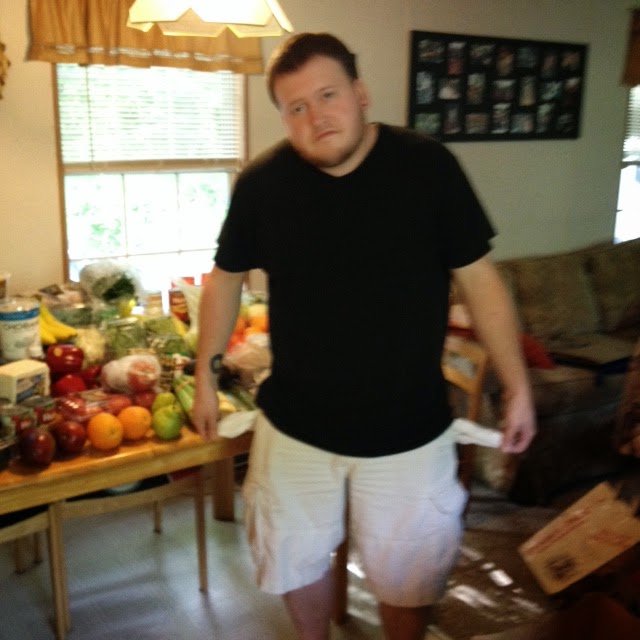
J: "60 grocery items and not an Oreo in the bunch..."
But still, this is a cost-prohibitive menu for many; I know we couldn't do this year-round. I"m a bargain shopper - I will go from store to store and back looking for the best deal (we did that today to J's chagrin) and I was struggling to find products with suitable price tags. For example, at Harris Teeter I could hardly find any non-organic foods. They were all farm raised, free-range items that were at least 10% more expensive than their (absent) counterparts normally are.

And that's one of the biggest issues with food insecurity and health in the US. Fresh, unprocessed (read:good for you) food is much more expensive than junk food. While begrudgingly shopping (it went from fun to tiring quickly), we talked about how although it wouldn't be nutritious and certainly would lose it's deliciousness quickly, a loaf of bread, jar of peanut butter and some lunch meat would help a paycheck or SNAP (food stamps) go much further. And if you're in a tight spot, sometimes choosing between the dollar menu and organic produce has to be a choice about money.

Many areas are fighting this trend; farm gleaning projects bring fresh produce to food pantries, neighborhoods are starting community gardens and co-ops, and buying local CSAs provide reliable and less expensive produce, but in many places, these projects don't exist.

Which brings me to my next point. Clean eating is...potentially geographically biased. Another major issue with food disparities in the US is the undeniable presence of food deserts. Food deserts are places where "fresh produce is scarce and greasy food abounds." Think of big cities where the only sources of "groceries" are corner markets that are cramped and filled with non-perishable, processed items or rural areas where grocery stores are difficult to reach, especially without owning a car. This is a reality for many people and we were very aware of this while shopping. We actually drove an hour to Asheville where we knew we could find all of the ingredients we needed, and even then had to go to over four stores. There were many items we were skeptical about finding, and especially finding in good quality, quantity and pricing in our hometown. We stopped at our local grocer on the way home for goods we knew they'd have (at great prices) and saw some of the things we thought required a trip to Trader Joe's or Earthfare, but that isn't the reality for everyone.

Here are some of the items we didn't think we would find (or find affordable) in our town - quinoa, chia seeds, ground flaxseeds, tamari and medjool dates.


From the shopping trip alone, we can tell that this detox may also be... time consuming. There will be considerably more prep-time required as opposed to making Hamburger Helper or picking up a pizza. And while that can be another disadvantage for the working class, this detox plan does offer very detailed instructions for multi-tasking and make-ahead meals and freezer pouches.

But, so far, I can say my overwhelming feeling about clean eating is...excitement.  I do not doubt this will have challenging moments: some of these foods are not my cup of tea, and speaking of tea, J is already dreading going without coffee and only being allowed three cups of unsweetened green tea per day; and I think I may struggle with hunger. Yet, I'm still excited to try new things. I can honestly say that I've never made any of these recipes before and without the menu would never buy 30% of these items .


I think it's going to be fun, delicious, and most importantly, good for us!

Buzzfeed promises we'll feel like this when it's over..


We'll certainly share pictures of our moods - and dance moves - throughout the process! Stay tuned!

Saturday, March 8, 2014

Simple Touches Make A Big Difference

I've mentioned before that while I appreciate slow dishes, stewed to perfection and take a real commitment of time, and usually high quality ingredients, I also love meals that are super fast and inexpensive. I don't always have the time or money required for some of my favorite recipes and we have to use simpler, often pre-packaged items in a pinch - and we're certainly not the only ones.

Food insecurity and food deserts are real issues across the country - and even our own community. With wealth disparities also come deficits of time for cooking and an inability to buy expensive, fresh ingredients. However, I want to plead the case that just because a meal involves simple, "low-brow" or pre-made/pre-packaged components doesn't mean it has to be any less special, delicious or full of love. I would argue that little, homemade, heartfelt choices can jazz up a meal that would otherwise be straight from the box (literally) and I want to share two such recipes - that we use frequently - with you.

When I was little, we were in a different place financially, and living in a rural area my family didn't know a lot about food. We ate a lot of country (and inexpensive) staples like cornbread, biscuits, potatoes and green beans, jellies and meats we canned ourselves. The majority of it was homemade but nothing like the crazy things my dad makes now (like bibimbap?!) and looking back at some of our "treats," I can't help but laugh. And it's absolutely not because I am ashamed or embarrassed, but the nostalgia of my childhood is just too funny to me.

One such treat, one of the first desserts I ever remember "making," was strawberry shortcake. We used to get these little pre-made sponge cakes that were practically flavorless (and only $1 for six!) and we'd top them with whipped cream and strawberries we'd cut up ahead of time and covered up sugar.

The sugar on the strawberries is the most important ingredient. It only takes about 2 T for a whole bowl of sliced strawberries, but left on them for a few hours, they make the most delightful, sweet juice - just perfect for shortcake! And instead of using plain white sugar, we use homemade vanilla sugar.

Feeling nostalgic, we made strawberry shortcake!
Albeit vanilla sugar does take some patience, but it couldn't be simpler to make and is easily refreshed. All you need is vanilla beans (we usually get Madagascar beans from MySpiceSage.com - they're a wonderful spice website that is inexpensive and gives freebies - usually vanilla beans - alot), white sugar and some sort of jar or airtight container.

Slice the beans in half so that you have two short halves, then split them open. Place them in your container and cover with sugar. We usually use half a bean per pint jar. Allow to sit for at least a month - the longer you leave it, the deeper the vanilla flavor. And whenever you've used up all of your sugar, just add more and repeat the process - the beans are very potent and will last through several refills.

After the sugar is ready you can use it in anyway you'd use regular sugar (in sweet dishes -- I wouldn't add this to chili or spaghetti sauce etc.). You could put it in your coffee, on french toast, in any pastry or, as we did, over sliced fruit. The vanilla adds a light sweetness and makes the most subtle, delicate changes in your dishes.

This is a wonderful touch for your dishes at home and adds a foodie feel to even the simplest of dishes, but it also makes a great gift. You can make it ahead in big quantities for holidays, decorate the jars and give out as beautiful and inexpensive gifts! We love our vanilla sugar so much that we actually gave out as favors at our wedding (with an added LEGO craft, of course).


Another quick, but impactful recipe is making your own seasoning for fries or homemade chips. We go to Grocery Outlet and stock up on $1.99 bags of french fries every few months and add them whenever we're short on side dishes. I am a french fry freak and I absolutely have a hierarchy of the best fries around and generally, frozen fries are on the bottom. However, using this Red Robin/Zaxby's knock-off seasoning, we're able to elevate ho hum fries into incredibly flavorful ones. And, the seasoning, which usually lasts us 3-4 months, costs less than $1 to make!


Mix 3 T salt (you could easily get away with 2 T if you're watching your sodium), 1 T instant tomato soup or spaghetti sauce mix, 2 t chili powder, 1/4 t ground cumin and 1/4 t ground black pepper. Store in an airtight container. 

I use this seasoning on practically any potato-product, but be sure to sprinkle this on immediately after cooking the dish - right after the fries come out of the oven/fryer etc. - to be sure it will stick. 


Providing a good meal doesn't have to involve a lot of time or money! I hope you take these two recipes and find your own way to incorporate small, homemade touches into your meals - making your own salad dressings and sauces or finding ways to jazz up boxed meals (check out Semi Homemade by Sandra Lee). 


Friday, December 13, 2013

National Food Insecurity

As you already know, food is a major fascination of mine. But an even more important part of my life is my dedication to service. I've spent a majority of my adult life involved in various volunteer leadership positions, service groups and projects dealing with issues such as HIV/AIDS, childhood education, cancer prevention and research, and poverty. And in recent years the intersection of these two passions - service and food - has become a working to end local food insecurity.

Oftentimes when we think of hunger and starving, undernourished children we think of foreign developing countries, not our own backyards. However, in Western North Carolina poverty, and especially hunger, are major issues. It is estimated that one in four children suffer from hunger and Asheville was recently named the 9th Hungriest City in the US.

There are many organizations working to alleviate these issues but they are under increasing stress from limited budgets and exponential need; and oftentimes they depend upon community donations to stay open. And this is why I am so excited about the work of my colleagues and the students at our institution.

This is the 2nd year we have hosted a food drive for MANNA Foodbank's MANNAPacks program. The MANNAPacks program packages bags of food for local K-12 students who receive free or reduced lunch and are at risk to go hungry over the weekends. They're given the bags on Friday afternoons which contain enough goodies and meal options - like instant oatmeal, rice, canned meat, powdered milk and peanut butter - to last them until Monday morning.

This year we were able to raise over 1,400 items for MANNA!


And at this year's employee holiday dinner we also collected hundreds of items for food assistance agencies in service area.

It's unfortunate, but true - food insecurity is everywhere in our country and we have to address it. But thankfully, there are food assistance organizations almost everywhere too - but they desperately need our support. Government funding is down, community giving is based upon the economic strength of the people and with more people in need of food that donation pool is smaller too.

Please seek out your local food pantries and soup kitchens to find a way to get involved - you can give of your pantry, your pocket or your time. Also, there are national organizations working to end hunger, especially in children. Share Our Strength is one of the front runners in alleviating childhood hunger nationally. Please consider making a donation or hosting your own fundraisers to feed families!